Make your own audiobook+Make your own audiobook
Poster for The Prefect's Enforcers

The Prefect's Enforcers

From The Offline

When the school's student prefect system breaks down during an extended blackout, a fourth-year prefect discovers that his predecessors' handwritten discipline records—hidden in a locked drawer—document a pattern of punishment that predates the headmaster's tenure. As he realizes the system was designed to perpetuate itself through chosen enforcers, he must choose between burning the evidence and becoming complicit in the next cycle of control.

Graphene
Written. Spoken. Yours.
Graphene
Written. Spoken. Yours.
←

The Prefect's Enforcers

6 chapters · ~29 min read

novella

When the school's student prefect system breaks down during an extended blackout, a fourth-year prefect discovers that his predecessors' handwritten discipline records—hidden in a locked drawer—document a pattern of punishment that predates the headmaster's tenure. As he realizes the system was designed to perpetuate itself through chosen enforcers, he must choose between burning the evidence and becoming complicit in the next cycle of control.

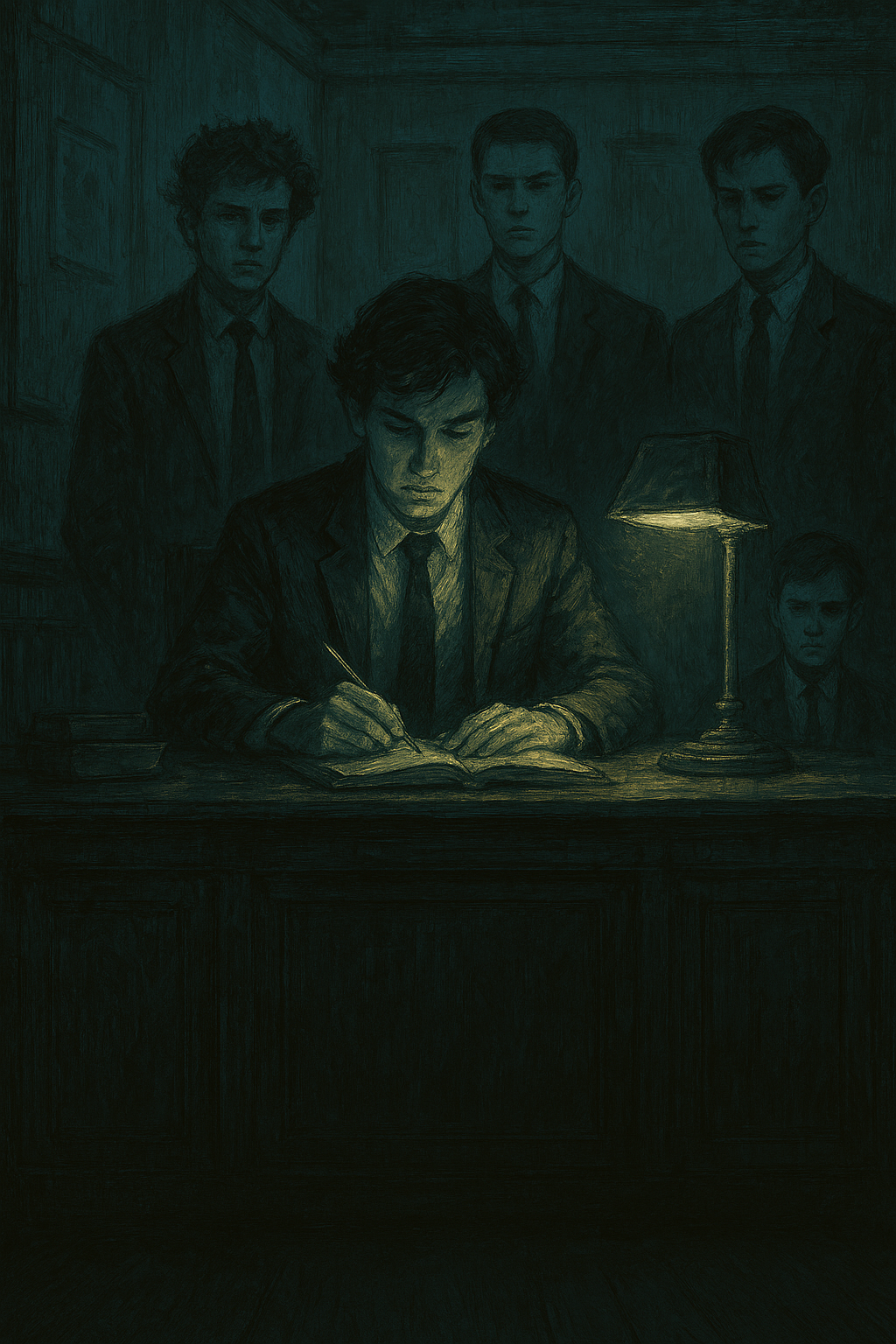
St. Ignatius prefect office, a wood-paneled room adjacent to the dormitory commons, late evening during a blackout; the scratch of pen on paper audible in the fluorescent hum that continues despite the surveillance shutdown.

Made with Emberkiln
Chapter 1 · ~5 min read

Whispers in the Dark

7:13

The torch was the kind they kept in the supply closet for fire drills, rubber-handled, heavier than it looked, and at seven minutes past nine on a Tuesday in October it was the only working light in the east wing of St. Ignatius. Marcus Chen had set it on its base, upright, so the beam threw a trembling cone against the ceiling and washed back down across twelve boys in varying postures of not-quite-sitting.

•••

The fluorescent hum was gone. That was the first thing he had noticed, more than the dark. The building made a sound when it was working, a low electrical breath you stopped hearing after your first week as a boarder, and when it cut out you heard the absence before you understood what had happened. Then the corridor lights had stuttered and held for a moment at half-strength, the colour of weak tea, and then they had gone too.

•••
“

The building made a sound when it was working, a low electrical breath you stopped hearing after your first week as a boarder.

The prefect office was wood-panelled, narrow, lined on three sides with the framed photographs of head boys going back to a year Marcus could not read from where he was sitting. On the fourth wall, behind his shoulder, a clock had stopped. He had not looked at it. He knew it had stopped because nothing in the room was moving except the boys, and the second hand was not part of what he could hear. He opened the register. He did not need the register. He opened it because opening it was a thing prefects did, and the sound of the cover hitting the desk was a sound the room recognised. "I'll be reading names," he said. "You'll respond when called. We'll wait here until staff confirm the all-clear. By the book."

•••

His voice arrived a half-beat before he did. It was not exactly his voice. It was a voice he had been issued, two years ago, along with the badge and the second-floor room and the key that opened this door and no others. He had practised it in the mirror over the dormitory sinks until it stopped sounding like a borrowed coat. "Ashworth." "Here." "Bell." "Here." The smallest boys were the easiest. They had the habit of answering in classrooms, and a roll call sounded enough like a classroom to do the work for him. He moved through the second-years with the cone of light over his shoulder and the pen in his hand making a small dry scrape against the paper, which was a sound he liked, which was the sound of something getting done. It was in the third-years that the room began to lean.

•••

Not loudly. A boy near the window had turned in his chair so that he was facing another boy at an angle the chair had not been designed for. Someone behind him was breathing through his nose in a way that meant he was about to laugh. There was a whisper, two rows back, which stopped when Marcus's pen stopped, and resumed when it started again, slightly louder, as if the whisper were measuring him. "Wexford." Callum Wexford stood up. He did not say anything at first. He was a tall boy for fifteen, and he stood the way boys stand when they have never been hit by an adult, with his weight even on both feet and a small smile that was already deciding what the next thing would be. "Sit down," Marcus said. "I need the toilet." "Sit down, Wexford." "It's an emergency."

•••

The smile widened by a fraction. Marcus felt the room turn its head, very slightly, like an animal noticing weather. He understood, with a clarity that surprised him, that there was no script for this. The intercom on the wall was a piece of beige plastic. The camera in the upper corner was a piece of glass with nothing behind it. The protocols were taped to the inside of a cupboard he could not see in this light. He had a torch, a register, and a voice that was not quite his. A hand went up in the second row. A second-year, one of the quiet ones, whose name Marcus had called four minutes ago and could not now remember.

•••

"Sir," the boy said, which was the wrong word, prefects were not sirs, but the boy had said it like a question and not a mistake. "Could we just wait. Please. Until the lights." It was not addressed to Callum. It was addressed to the room, and to Marcus, and to the situation, as if the situation were a fourth presence that could be reasoned with. Callum's smile faltered. Not much. Enough. Marcus closed the register. The cover came down harder than he meant, and the sound of it carried, and the room went still in a way that felt, for a moment, like obedience. He looked up.

•••

Most of the boys were looking at the desk, or the floor, or the dim shape of the door. One boy in the back row was looking at him. Marcus did not know his name. The boy did not look away when their eyes met, and he did not look away when Marcus held the look longer than was comfortable, and he did not look away when Marcus finally, deliberately, returned to the register and pretended to find his place. "Wexford," Marcus said. "Sit." Callum sat. Marcus let out a breath he had not been keeping track of. He reached for the torch to angle it more usefully across the page, and his hand met the rubber grip, and the rubber grip, which had been balanced on a base designed for a slightly different model, rolled.

•••

It rolled an inch. It rolled another inch. It went off the edge of the desk with the unhurried certainty of an object that had been waiting all evening to do exactly this, and it hit the floor, and the bulb, which was old, went out. The dark, when it came, was complete. Not the dark of a room with curtains. The dark of a room with no light at all, in a building with no light at all, on a corridor with no light at all, at the centre of a school whose generator had not, it seemed, been tested in some time. For one second Marcus heard nothing. For the second second he heard twelve boys breathing, and understood that he could not tell which breath belonged to Callum and which belonged to the boy in the back row.

•••

The third second was the longest. At the end of it, somewhere to his left, a chair leg moved against the floor.

•••
Next · Ch 2 →
The Broken Chain
Chapter 2 · ~4 min read

The Broken Chain

6:09

The locked drawer sat flush in the desk's lower left corner, its brass keyhole worn bright by years of thumbs that knew exactly where to find it. Marcus had been looking at it for eleven minutes. He knew because the wall clock above the door was the old kind, with a second hand that ticked audibly, and during a blackout the ticking is the only thing in the room that behaves like time. The overhead fluorescents hummed. This was the strange part, the part nobody talked about. The cameras were down. The intercom was down. The card readers on every dormitory door had gone dark hours ago. But the prefect office lights stayed on, drawing from somewhere the rest of the building couldn't reach, as if the room itself had been wired against the dark.

•••

He pulled the letter opener from the cup on the desk. It was brass, heavy, the kind of object that pretends to be ceremonial until you need it to be a tool. He weighed it in his hand. He set it down. He picked it up again. There is a version of Marcus Chen that closes the drawer he hasn't yet opened, finishes his shift, and goes to bed. That version existed up until about eleven minutes ago. It is worth noting that he is not that version anymore, and that the change happened before he understood it was happening. He wedged the brass tip into the seam above the lock and leaned.

•••

The sound was louder than he expected. A dry crack, the report of old wood giving up a secret it had been paid to keep. He froze. He listened. Down the corridor, somewhere past the commons, a door closed. Not near. Not far either. Fiona made her rounds on no schedule he had ever been able to map, which he suspected was the point. He waited until the corridor was only the hum again. Then he pulled the drawer open. There were six of them. Leather-bound, the spines cracked in that particular way leather cracks when it has been opened and closed across decades by hands that did not love it but needed it. They were stacked with a tidiness that bothered him before he understood why. Not jammed in. Not piled. Arranged. The way you arrange something for the person who will find it.

•••
“

He wedged the brass tip into the seam above the lock and leaned.

He lifted the top ledger free and set it on the desk and opened it. The handwriting in the first pages was beautiful in the way that frightens you. Copperplate, even-spaced, the loops of the g and the y descending to identical depths. He turned to the next page. The same hand. He turned twenty pages forward. The same hand. He flipped to the back of the volume, where the dates jumped a decade, and the hand had changed, but only slightly, the way a son's signature resembles his father's. He went back to the front. The dates at the top of the earliest entries read nineteen sixty-one. Nineteen sixty-two. Nineteen sixty-three. Richardson had been headmaster for eleven years.

•••

Marcus turned a page. Then another. He read names he didn't recognize, attached to infractions in a vocabulary the school no longer used. Insubordination at chapel. Failure of bearing. Conduct unbecoming a junior of the house. Beside each name a notation in a smaller hand, a single word or two. Corrected. Reassigned. Removed. He was reading without thinking, the way you read a thing you intend to put down in a moment, and then he saw a name he knew. Callum Wexford. He stopped. He read it again. The entry was dated four years ago. Callum Wexford had enrolled at St. Ignatius last September. Marcus put his finger on the line and held it there, as if the page might rearrange itself if he looked away. The notation beside the name was in the same small hand as the rest, and it said, accelerated pathway assessment, conditional enrollment, supervised placement.

•••

He sat back. The chair creaked. The fluorescents hummed. Somewhere in the building a door opened and did not close. He turned the page. He kept turning. He was looking now, not reading, hunting through the columns of dates that should not have been possible, dates that preceded the boys they were attached to, and the small uniform hand kept providing them, calm and even, in ink that had dried decades before some of these students had been born. There was a name he was trying not to look for. He understood this about himself in the way you understand the shape of a room you are crossing in the dark. He was not going to look for it yet. He was going to read the rest first. He was going to earn it.

•••

He heard footsteps in the corridor. Measured. Unhurried. The particular weight that Fiona's shoes made on the parquet, which he had spent a year learning to identify so that he could be standing when she entered any room. He did not move. He did not close the ledger. The footsteps passed the door and continued on, and the sound of them faded toward the east wing, and Marcus exhaled a breath he had not been aware of holding. The broken lock lay on the desk beside the open drawer, and the drawer was full of notebooks stacked so neatly they could only have been arranged to be found.

•••
← Previous · Ch 1
Whispers in the Dark
Next · Ch 3 →
Masks Slip
Chapter 3 · ~5 min read

Masks Slip

7:01

Fiona Halvers came through the prefect office door at twenty minutes past nine, and she did not knock. She did not need to. Her badge sat straight, the pin level with the second button of her blazer, and the torch in her hand was not pointed at the floor where she walked. It was pointed at Marcus Chen's face. He did not flinch. That was something he had practiced. "You're working late," she said. "Paperwork." "In a blackout." "The fluorescents are on." She lowered the torch by a degree, not enough to be courtesy. The beam slid down his collar and across the desk and stopped at the stack of ledgers he had not had time to put away. He had heard her in the corridor. He had heard her three doors down and he had still been one motion too slow.

•••

Fiona is sixteen and a half. She placed third in the regional debating tournament last spring and her mother is on the board of governors, which is a fact she has never once mentioned and which everyone knows. She speaks like someone who has been told her whole life that she is clever, and she has decided to be exactly that and nothing softer. "I've drafted the duty roster," she said. "For tonight." She set a folded page on the corner of the desk. She did not sit. "I haven't seen a request for one." "You wouldn't have. The commons is loud. Third-years are out of their rooms. Someone has to walk the east stair." "That's standard procedure." "Then it shouldn't be a problem."

•••

Marcus unfolded the page. Her handwriting was small and even. Six prefects, six stations, paired in twos, the pairings precise. He read down the column and stopped at the third line. A name he had read forty minutes ago, in a ledger from 1987. Not the same student. A grandson, possibly. A nephew. The surname was uncommon enough that it was not a coincidence and common enough that he could not say so. The boy was assigned to the east stair. With Fiona. "I'd like to redo the pairings," Marcus said. "Why." "Distribution. You've put both fourth-years on the same wing." "I've put the strongest pair where the noise is loudest." "It leaves the west side thin." "The west side is asleep."

•••

He needed a reason and he did not have one he could say. He looked at her, and he made his face do the thing it did when he was about to refuse a student without raising his voice. He had practiced that too. He needed to be the prefect right now. He needed to be the prefect right now and the prefect did not look at a duty roster and say, I have read a notebook in a drawer and I know what happens to boys with this surname on the east stair at night. "Swap him with Patel," Marcus said. "Patel's taller. Better for the stair." Fiona tilted her head, the smallest amount. "Patel has a chest cold." "Since when." "Since this afternoon. He told me at supper."

•••

Marcus had sat across from Patel at supper. Patel had eaten everything on his tray and asked for seconds of the bread. "Then Okafor," Marcus said. "Fine." It was too easy. She agreed too easily, and she was still standing, and her torch was still on, and he understood then that the roster had never been the point. She reached across the desk. She did not ask. She lifted the topmost ledger, the one from 1987, and she opened it to the page he had been reading. She read one line. Her eyes moved once, left to right, and stopped. She closed the ledger. She set it back on the stack. She said nothing.

•••

That was the part Marcus would think about later, walking the corridor in the small hours, repeating it to himself the way you repeat a combination you are afraid of forgetting. She said nothing. She did not ask what it was. She did not ask why he had it. She did not ask whose handwriting filled the margins or why the cover was cracked along the spine in the shape of a thumb that was not his thumb. "Goodnight, Marcus," she said. "Goodnight." She took the folded roster with her. She did not take the corrected version. The pairing for the east stair, as she walked out, was still hers. He sat for a long time after the door closed. The fluorescents hummed. Somewhere in the commons a chair scraped and a boy laughed and the laugh cut off the way laughter does when someone older walks into a room.

•••

Marcus looked at the ledgers. He had left them in chronological order. Oldest at the bottom, 1987 on top, his own year three down from there. He had been precise about it. He had been precise because precision was the only thing in the room that still belonged to him. The 1987 ledger was on top. The one beneath it was not the one that should have been beneath it. The order had shifted by two. Not enough to look disturbed. Enough that he knew. He had been gone from the desk for less than a minute, earlier, when he had stood to check the corridor. He tried to remember whether she had been near the desk during that minute. He could not remember. He could only remember the torch on his face, and the badge straight, and her hand on the ledger as if she had done it before.

•••
“

She speaks like someone who has been told her whole life that she is clever.

He stacked them again in the correct order. He sat down. He opened the 1987 ledger to the page she had read, and he read the line, and he read it again, and he understood that he did not know what she had seen in it. Down the corridor, a door closed softly. Not slammed. Closed, the way a person closes a door when they do not want to be heard closing it. The east stair was three minutes' walk from the prefect office. Marcus reached for the roster he had drafted in his own hand, the one with Okafor on the east stair, and he found that he had not actually written it down. He had only said it. Out loud. To her.

•••
← Previous · Ch 2
The Broken Chain
Next · Ch 4 →
Shadows of Choice
Chapter 4 · ~5 min read

Shadows of Choice

7:31

The clock on the gymnasium's east wall reads eleven forty seven. It has read eleven forty seven since 1982, when a thrown basketball cracked the glass and nobody saw fit to fix it. The boys at St. Ignatius have grown up under that time. They schedule nothing by it. They look at it the way you look at a saint in a niche, which is to say, they stop seeing it. Marcus is seeing it now. He is seeing it because Fiona has just stopped talking, and the room has the particular silence of a place built for noise. Sneakers and whistles and the squeak of folding chairs. Tonight, none of that. Tonight, the fluorescents hum on a circuit nobody can find the breaker for, and Marcus has a manila folder under his arm that he should not have brought.

•••

He didn't mean to bring it. He'd meant to leave the ledgers in the drawer and come down here clean. But the folder is under his arm, and Fiona is twelve feet away, and he is thinking about how long it would take him to get back upstairs to the office. Three minutes if he ran. Less if he didn't care who saw. She is sitting on the lowest bleacher with her hands folded the way she folds them in chapel. Marcus has known Fiona since their second year. He has watched her correct a teacher's Latin and then apologize for it in the same breath. He has watched her run a study hall so quiet you could hear the radiators tick. He has, in retrospect, watched her watch him. "You've read them," he says. "I've read what?" "Don't."

•••

She tilts her head. "Marcus. You came down here with a folder and a face. I'm trying to understand what you think I've done." This is the thing he keeps tripping over. Every question he asks her arrives at his own feet rephrased. He came in wanting an admission and she has, in the space of four minutes, converted his certainty into a list of things he cannot quite prove. "Callum Wexford," Marcus says. "Two weeks ago. You wrote him up for insubordination and assigned him the equipment shed inventory. Alone. After lights out." "That's a standard sanction." "It's the same sanction a prefect named Donnelly gave a third year in 1991. Same offense. Same shed. The boy's name was Wexford." A pause. Not long. Fiona is too careful for long pauses. "Wexford is a common name in the catchment," she says. "It's not." "It's common enough."

•••
“

He'd meant to leave the ledgers in the drawer and come down here clean.

Marcus opens the folder. He does not mean to. His hand does it. He is looking at the first page, which is not the page he thought was on top, and he sees a margin note he did not see upstairs. Small handwriting, blue ink, slanted the other way from the entry it sits beside. Three letters. M C. Then a date, two years before he arrived at this school. He closes the folder. He has, suddenly, the sensation of having been read. "Marcus." "The Henley boy," he says, and his voice is doing something he doesn't recognize. "You moved him out of the east dorm last month. To the single on the third floor." "He requested it."

•••

"In 1978 a prefect named Aldridge moved a second year named Henley to a single on the third floor. The note in the ledger says, quote, isolation phase, six weeks, monitor for compliance shift. The Henley boy hasn't spoken in a week, Fiona. He used to argue with everyone. Now he sits at the end of the table and eats with his head down." She looks at him for a long moment. There is something almost kind in her face, and that is the worst of it. "You're describing a pattern," she says, "that you've only just learned to look for." "I'm describing a playbook." "You're describing recognition bias." "Fiona." "Marcus, listen to yourself. You found a drawer of old paper and now every disciplinary action in the building looks like a quotation. Do you hear how that sounds?"

•••

He hears how it sounds. He hears, also, that she has not asked him what was in the drawer. She has not asked him where the drawer is. She has not asked him how old the paper is or whose handwriting filled it. She is conducting a conversation about records she has, ostensibly, never seen, and she is doing it without a single question about them. He says, quietly, "You knew before I did." She doesn't answer. She reaches into the pocket of her cardigan, takes out a folded square of paper, and sets it on the floorboards between them. She slides it across with two fingers. It travels about four feet on the varnish and stops short of his shoe. "Read that," she says, "and then decide what you'd like to accuse me of."

•••

Marcus picks it up. It is a page torn from a ledger he has not yet opened. At the top, in the clean block print of an administrative hand, is his own name. Marcus Allen Chen. Beneath it, a column of assessments he does not have the stomach to read in front of her. He reads them anyway. Empathy index, declining, acceptable. Deference to authority, high. Capacity for procedural reasoning under stress, exceptional. At the bottom, in the same blue ink as the margin note upstairs, three words. Prefect track confirmed. The date is two years before his enrollment. When he looks up, Fiona is already at the gymnasium door. She has moved without sound. She turns, one hand on the frame. "I'll see you upstairs," she says.

•••

And then she is gone, and Marcus is alone on the polished floor of a room built for games, holding a piece of paper that says he was chosen before he could choose. His hand is shaking. He hadn't noticed. He notices now. He looks up, because he has to look somewhere that isn't the page. There is a skylight above center court. He has been in this gymnasium nine hundred times and he has never once looked up. The skylight is narrow, set deep into the rafters, and through it he can see a single thin band of sky. The blackout has taken the campus lights. The stars are out. There are more of them than he remembered there being. Somewhere above him, in the office he left unlocked, a drawer is waiting to be reached first. He does not move.

•••
← Previous · Ch 3
Masks Slip
Next · Ch 5 →
Chains of Control
Chapter 5 · ~5 min read

Chains of Control

7:14

The dormitory corridor at St. Ignatius has its own weather. Disinfectant, mostly. Underneath that, the dry paper smell of an old building that hasn't had a window opened in a decade. And tonight, underneath even that, something Marcus can only call fear, though he would not use the word out loud. It comes from the third door on the left, where a boy is crying in the controlled way boys cry when they know they're being listened to. Marcus walks the line of closed doors. He has the page folded in his blazer pocket. He has, in the other pocket, three more pages he tore from the 1989 ledger before he left the office, and one of them has the precedent he is almost certain is about to be used on Declan Marsh.

•••

The precedent is forty years old. Isolation room, seventy-two hours, no visitors, prefect-witnessed. Issued originally to a boy whose name has been scratched through so many times it looks like a wound. The infraction listed beside it is the same phrase that appeared on Fiona's order an hour ago. Conduct unbecoming, repeated. Three words. Nothing under them. Declan is fifteen. He has, to Marcus's knowledge, done nothing this week except ask too many questions in the commons about why the lights upstairs are working. Two senior prefects are already at his door. Henley and Park. Henley is holding the form. Park is holding Declan by the upper arm in the way they were taught, the way that looks like guidance and feels like a vise. Marcus stops at the end of the corridor.

•••

He could speak now. He has, in his pocket, the entire architecture of the lie. He could unfold the 1989 page and hand it to Henley and watch Henley's face do whatever it would do. Henley is not a bad person. Park is, on balance, a decent one. They would read it. They would have to read it.

•••
“

The infraction listed beside it is the same phrase that appeared on Fiona's order an hour ago.

And then every prefect on this floor would know that the system Marcus and Fiona and the four of them above them have been running, the system that gave Henley his stripe last spring and Park hers in autumn, is not a system at all but a script. And half of them, Marcus knows with the cold accuracy he has cultivated over four years, would not thank him for the knowledge. Half of them would close ranks around Fiona, who issued the order, because Fiona issued the order, and because the alternative is to admit that their own names might be in a drawer somewhere too. Declan looks up. He sees Marcus at the end of the corridor.

•••

He does not say anything. He does not have to. His face does the thing fifteen-year-olds' faces do when they have, against their better judgment, decided that one of the older boys is going to fix it. Marcus's hand is in his pocket. His fingers are on the folded page. The headmaster's door opens behind him. Richardson comes out of his office with the form already in his hand, because Henley has, at some point in the last ten seconds, walked it down to him and walked back. Richardson does not look at Marcus. He looks at the form, and then at Declan, and then he uncaps his pen with the small efficient gesture of a man who has signed a great many things in his life and intends to sign a great many more. By the book, he says, to no one in particular. Gentlemen. He signs.

•••

The pen makes the sound pens make. Marcus has heard it a thousand times in the office above and never noticed it. Tonight it is the loudest thing in the building. Richardson hands the form to Henley. Henley hands it to Park. Park opens the door to the isolation room at the end of the hall, which has been unlocked, Marcus understands now, since before any of them got here. Declan is walked through it. He does not look back this time. He has, in the four seconds it took Richardson to sign, learned something about Marcus that Marcus has just learned about himself. The door closes.

•••

Richardson goes back into his office. He has not, the whole time, registered Marcus's presence in any way that Marcus could later describe. Whether this is because he didn't see him, or because he saw him and counted on him, is a question Marcus is not going to be able to ask tonight. The corridor is quiet. The fluorescent hum, which has been running since the blackout started, keeps running. Marcus stands in it for what is probably less than a minute. Then he walks. Past Henley, who will not meet his eye. Past the isolation door, behind which he can hear nothing yet. Past the stairwell to the prefect office, which he does not take.

•••

At the far end of the hall, outside the room shared by two third-years he doesn't know well, the shouting that has been building for the last several minutes stops. Just stops, the way a radio stops when someone pulls the cord. Marcus turns the corner. On the floor outside the door, two prefect badges. Set down, not thrown. Side by side, the way someone places things they have decided, calmly, they will not be picking back up. From inside the room, a voice he recognizes as Jake Barnes's says something short and quiet that Marcus cannot quite make out. Then nothing. Marcus stands over the badges. He does not pick them up. He does not knock.

•••

At the other end of the corridor, the door to Fiona's room is open by perhaps two inches. She is, he understands without needing to look, watching him. She has been watching him, he understands further, for considerably longer than tonight. The order she signed an hour ago used a precedent number. The precedent number was not in any document available to current prefects. It was in the 1989 ledger, in the drawer Marcus believed, until this moment, he had been the first to open. He does not turn toward her door. He stands in the hum, between the isolation room and the two abandoned badges, and the corridor at St. Ignatius does what corridors at St. Ignatius do. It waits.

•••
← Previous · Ch 4
Shadows of Choice
Next · Ch 6 →
Burning the Past
Chapter 6 · ~5 min read

Burning the Past

7:17

The ledgers were open on the desk in a fan, the way you'd fan a deck of cards before a trick. Twenty-three of them. Marcus had counted while he waited. He had the broken drawer face leaned against the wall behind him like evidence at a trial nobody had convened yet.

•••

The door was open. The hallway beyond it was dark in the way the school had been dark for two days now, dark with the particular flatness of a building that had given up pretending. Boys had come down in their housecoats and their uniform trousers and one in just socks. Jake Barnes stood inside the threshold with his arms crossed. Lucas Jameson stood three feet behind Jake, which told you something about Lucas if you knew how to read it. The second-year, the one who had once raised his hand and said please wait, was near the front, watching Marcus the way you watch a person on a ledge. Fiona was already in the room. She had come in first. She had two prefects with her, Hollis and Wren, standing at her shoulders like a punctuation mark.

•••

Marcus said, "These are the discipline records. They go back to nineteen sixty-one." His voice did the thing it always did under pressure, which was to flatten into procedure. He let it. Procedure was the only register the room would believe. "Every prefect in this school was chosen before he arrived. Including me. Including Hollis. Including Fiona." Hollis did not look at Fiona. That was the tell. "My name is in the ninety-seven book," Marcus said. "Two years before I sat the entrance exam. The note next to it says empathy erosion, leadership vectors, prefect track. The note says I was selected for doubt. Because doubt, properly managed, makes the most reliable enforcer." He felt the sentence land in his own chest before it landed anywhere else. He had not said it out loud before. He had not let himself. Someone in the hallway said, quietly, Jesus.

•••

Fiona spoke without moving. "Marcus. Think." "I have." "If you burn them, you have nothing. You have a story. They will call it a story. Richardson will call it a story." Her voice was even, which was Fiona's whole arsenal. "Keep them. Use them. We bring this to the board, to the parents, to a newspaper. You and I together. We end it properly." It was a good argument. It was the argument he had been rehearsing against himself for four hours. "You read these before I did," Marcus said. "Yes." "How long before." A pause. "Eight months." Jake made a small sound at the door that was not quite a laugh. Fiona stepped forward. She reached, calmly, the way a teacher reaches for a confiscated phone, for the topmost ledger. Marcus caught her wrist.

•••

He was not a boy who touched people. He had gone through three and a half years of this school without putting a hand on anyone, which was itself in the notes, he understood that now, that restraint was one of the vectors. He held her wrist and he did not let go and the room went so still that you could hear the fluorescent tube above the desk, the one that had stayed on through everything, doing its small electrical work. Fiona looked at his hand on her wrist. Then she looked at his face. Whatever she saw there, she stopped pulling. "Marcus," she said. Softer. From the far end of the corridor, footfalls. Adult footfalls. The unmistakable cadence of Headmaster Richardson, who walked the way he spoke, by the book.

•••

Marcus let go of Fiona's wrist. He picked up the metal waste bin from beside the desk and set it in the center of the floor. He took the matches from the drawer where the prefects kept matches for the candles they were supposed to use in drills like this one. He lit the first ledger at its spine and dropped it in. The paper was old and it took fast. The light jumped up the wood panels and found the faces in the doorway and Marcus saw, in that first flare, the second-year's expression, which was not fear and not triumph but something more useful than either, which was attention.

•••

He fed in the second ledger. The third. Fiona did not move. Hollis took one step back, then another, and was in the hallway, and then was not in the hallway, and Marcus did not turn his head to see where he had gone. "You are still in them," Fiona said. Quiet. Only for him. "Burning them doesn't take you out of them." "I know." "It doesn't end it." "I know that too." Richardson's voice came from the corridor, sharp, calling his name, calling for order, calling gentlemen, calling by the book. The boys in the doorway did not part for him. Jake Barnes did not move. Lucas Jameson, who had spent every chapter of his life at this school calculating which side of a room to stand on, did not move either, and Marcus registered that and filed it and fed in the next ledger.

•••

The nineteen ninety-seven book he saved for last. He held it a moment. He did not open it to his page. He had read his page. He knew what it said. He dropped it in whole and it caught from underneath and the flame came up through the cover and ate his name from the inside out. The light in the prefect office was the brightest it had ever been. It moved on the walls in a way the fluorescent had never moved. It threw the shadows of the boys in the doorway long across the floor toward him, and his own shadow short and unsteady against the desk behind him. Richardson reached the threshold. Marcus heard him stop there. Heard him take in the bin, the bodies, the boy at the center of it.

•••

Marcus did not move to put it out. He stood and he watched the fire do its work and he understood, with a clarity that felt less like victory than like weather, that he did not know if this ended anything. He knew only that he had not handed it forward. That was the whole of what he knew. That was what he had. The last ledger collapsed inward on itself with a soft sound, and the light surged once, and held.

•••
“

He had not said it out loud before.

← Previous · Ch 5
Chains of Control
Back to show →
The Prefect's Enforcers